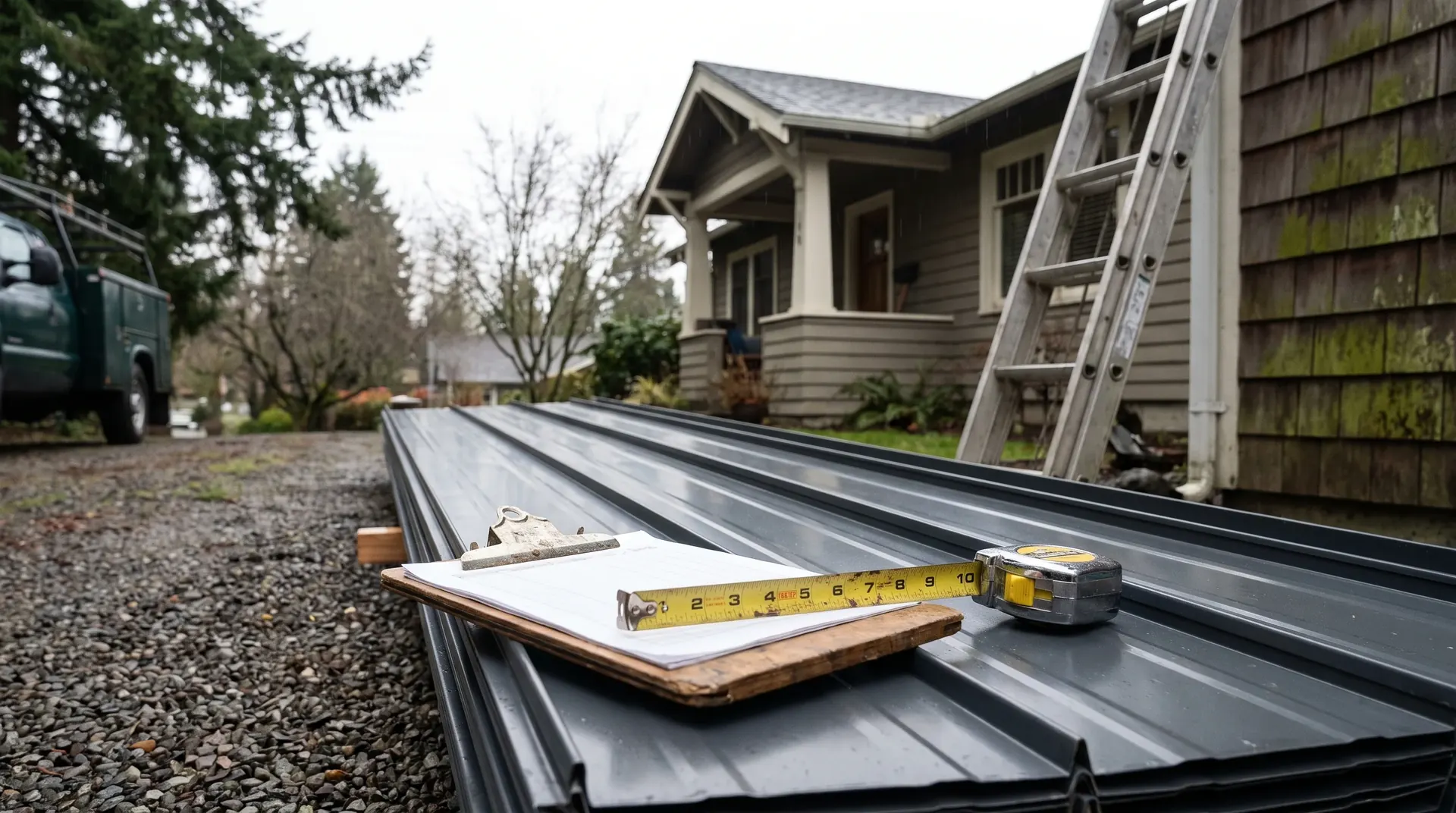
Nobody can tell you what your roof costs without seeing it, and anyone who gives you a number over the phone is quoting a different house. What we can do is tell you exactly what moves the number, so that when you get two estimates you can see why they differ.
There are seven things that decide the price. Square footage is only one of them, and it is rarely the reason two quotes are thousands apart.
1. How big the roof actually is
Not the square footage of the house. The roof area, which grows with pitch, and which includes overhangs, porch roofs and dormers. A 1,600 square foot bungalow with a steep gable and a wraparound porch can carry more roof than a bigger house with a simple hip.
2. Pitch and access
Steeper roofs cost more because the work is slower and the safety requirements are higher. Access matters just as much and gets forgotten: a house on a tight lot in Columbia or Sunnyland, with no room to put a trailer and a conveyor, costs more to work on than the same house on an open lot in Ferndale.
3. How complicated the details are
This is usually the biggest hidden variable. Every chimney, skylight, sidewall, valley, vent and dormer is a flashing detail, and flashing is where the labour and the risk live. Two houses of identical size where one has a simple gable and the other has three valleys and a chimney are not the same job.
Older Bellingham houses tend to be detail heavy. Craftsman homes with dormers, gable returns and porch roofs meeting walls are lovely and they take time.
4. Which panel system
Exposed fastener metal is the cheaper family. Standing seam costs meaningfully more, because there is more material in the seam, more labour to close it, and hidden clips rather than screws driven through the face.
The gap is real. Whether it is worth it depends on how long you are staying, since standing seam removes the fastener replacement cycle that eventually catches up with every exposed fastener roof.
5. Tear off and what is under it
Removing the old roof costs money, and disposing of it costs more. If there are two layers up there, that doubles.
Then there is the deck. Nobody can see the sheathing until the old roof is off, and in this climate soft spots are common under a roof that has been growing moss for a decade. A good estimate carries a written deck repair allowance so that a bad surprise is a number you already agreed rather than a phone call mid job.
6. Underlayment and membrane
The cheapest quote is often cheap here, and it is invisible once the roof is on. Synthetic underlayment across the whole deck and ice and water membrane at eaves, valleys and penetrations is what the climate needs. Skipping it saves a few hundred dollars and costs you the roof.
7. Who is doing it
A crew that installs metal every week works faster and makes fewer mistakes than a composition crew doing an occasional metal job. That can go either way on price. What it does reliably is change how much you spend on the roof over the following ten years.
What a written estimate should list
Your number will be your own, but the line items are not a mystery. Ask for these in writing from anyone you talk to:
- Panel system, profile and gauge
- Finish and colour
- Underlayment type and where membrane goes
- Flashing detail, and whether flashings are formed on site
- Tear off, number of layers, and disposal
- Deck repair allowance and the rate beyond it
- What is specifically excluded
When two estimates are far apart, the difference is almost always on that list rather than in the panels.
When it is worth getting a number
- The roof is over twenty years old and has never been assessed
- You are getting repairs more than once a winter
- You are planning to stay in the house and want to stop thinking about the roof
- You have an estimate from somebody else and want to understand what is in it
An estimate is free and it is written. If the honest answer is that your roof has years left, that is what it will say.